The Human Code
Our brains, and a world that grew very big very fast
Climate, inequality, burnout, loneliness: they look like separate problems, but they share one root. What we truly value — health, freedom, trust, a liveable planet — is too complex to fit in a single human brain. So we invented money: one number that makes that complexity manageable. Ingenious, but incomplete.
That is not a failure. It is how our brain works — and it is a story you are part of too, because we all share the same kind of code.
"Our economy works the way our brain works.
And our brain works with shortcuts."
Once we understand which shortcuts our brain takes — and what role money plays in them — we can build our society to fit who we really are, instead of hoping that we will suddenly become different people.
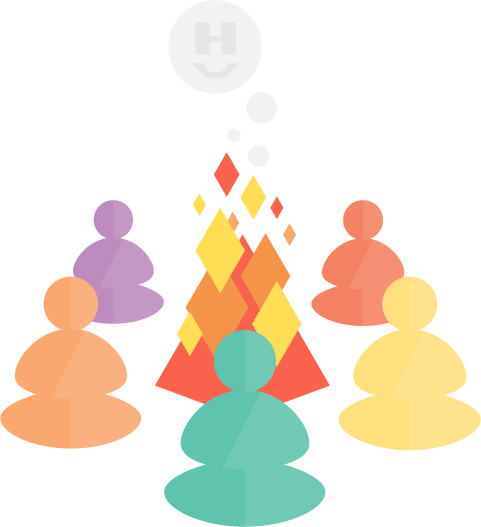
Then — around the campfire
We are made for small groups
For hundreds of thousands of years we lived in small groups, somewhere between 50 and 150 people. Everyone knew each other by name. Whoever did something well got a pat on the back straight away. Whoever did something wrong heard about it that same day. Our brains grew up in that world — a world where you could simply see and feel trust, honesty and cooperation.
Now — a world of billions
Our world has grown much bigger, incredibly fast
In just a few generations we have become eight billion. We share our planet with people we will never meet, buy things made on the other side of the world and make decisions that still matter generations later. Our brains are the very same brains from around the campfire. Not broken, just still catching up.
The limit of our brain
What we value is too complex to fit in a single mind
Health, freedom, trust, a liveable planet, time with the people you love, work that feels meaningful — what we truly value is multidimensional and depends on a thousand things at once. No human brain can take in all those layers at the same time, let alone weigh them fairly against each other. It is not unwillingness, it is biology: our brain simply does not have the bandwidth for it.
Our most ingenious shortcut
Money is a shortcut that makes that complexity manageable
To make decisions more easily and to exchange value with people we don't necessarily know well, we invented money. Money is a brilliant shortcut: a single number that lets us weigh the most diverse things — an hour of work, an apple, a roof over your head — against each other after all. It reduces the complexity of the world to something our brain can handle. But every shortcut has a price: whatever gets no price tag — clean air, trust between neighbours, the wellbeing of our grandchildren — barely registers in our minds.
A number, but never neutral
Money is a number with a story — and a feeling
On paper, money is a neutral number. In practice, it rarely is. For one person money evokes security, freedom and self-worth. For another, stress, shame, guilt or anger. Almost everyone carries — often unconsciously — a charged story about money. That is why conversations about money so quickly touch a nerve. And that is why a healthier money system is just as much about emotions and relationships as it is about economics.
That's why change feels hard
It's not the people — it's the design
Much of what is going wrong today — warming, inequality, burnout — is not because people are bad. It is because we live in a world our brain is not yet made for, and which we try to steer with a single shortcut. Once you understand that, you stop pointing at individuals and start looking at what we can design differently together.
The leap at a glance
Our brains change slowly. Our world changed in a few generations. Compare for yourself.
150
people back then
That's how many relationships our brain tracks effortlessly — throughout our entire evolution.
8 billion
people today
With this many we share the planet and our choices affect each other.
~250 years
time to catch up
In such a short period our world went global — our brains were not given that time.
Time to catch up!
We obviously don't need to replace our brain. What we can do is build new systems that let us be fully human. Systems, like money and AI, that give us security and fairness as well as freedom and meaning…
That is what Happonomy does. We don't build a new kind of human. We build tools, experiences and encounters that help our brain and our money system deal with this big, shared world — including the emotions that inevitably come with it.

How we do it
First feel, then do, then understand
Up for evolving with us?
Come along on the journey, at your own pace, in your own place.